Kadek Ananta Satriadi, Made Windu Antara Kesiman, … and Anthony Wilson. 2026. Participatory 3D Documentation of Thousands of Balinese Temples: A Preliminary Study. ACM Journal on Computing and Cultural Heritage (2026). Special Issue on Visual Heritage. To appear.

Kadek Ananta Satriadi
Human-centred computing researcher specialised in visualisation and spatial computing technologies.
Participatory 3D Documentation of Thousands of Balinese Temples: A Preliminary Study
Kadek Ananta Satriadi, Made Windu Antara Kesiman, Putu Hendra Suputra, I Gede Mahendra Darmawiguna, Tom Chandler, Bernhard Jenny, Kadek Teguh Dermawan, I Made Gede Sunarya, Joshua Seguin, Viviane Frings-Hessami, I Gede Danan Aria Satwika Punia, I Kadek Dwi Angga Sathya Nanda, Lanang Surya Darma, I Putu Bayu Ananta Surya, and Anthony Wilson
ACM Journal on Computing and Cultural Heritage. Barcelona, Spain. 2026. Publication type: full paper.
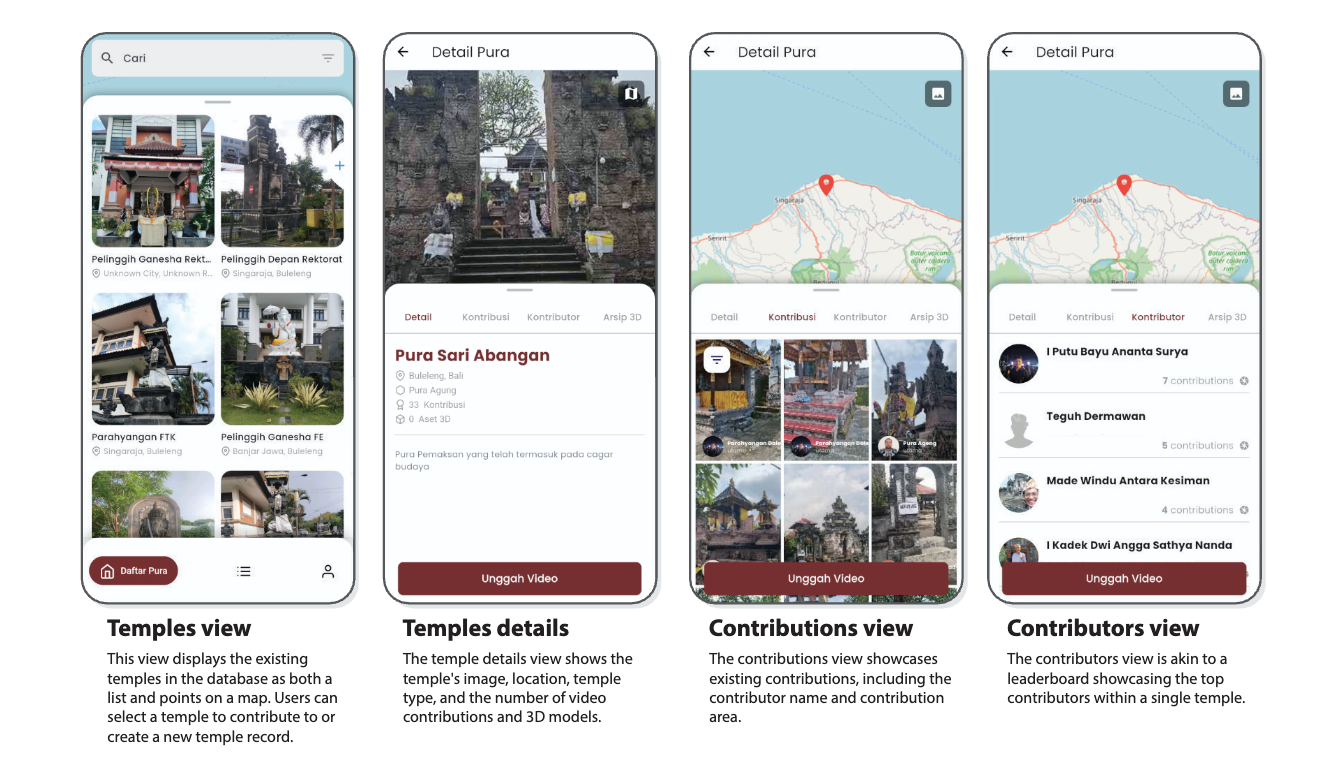
Documenting cultural heritage sites at scale through community-participatory approaches offers considerable promise. Our work investigates the feasibility of participatory 3D documentation techniques in the context of Balinese temples. Bali is home to thousands of sacred temples whose physical appearance has never been comprehensively documented. Documenting them presents four challenges: (1) the number of temples; (2) variation in temple size, environmental setting, and access; (3) time pressure from ongoing natural and developmental changes; and (4) complications arising from their religious significance. Using an action research methodology, we iteratively designed a participatory 3D documentation approach, realized through the BADHI (Bali Digital Heritage Initiative) digital platform. BADHI platform is an integrated system comprising a mobile application for video collection, a monitoring dashboard, a video-to-3D reconstruction pipeline, and a web viewer. Across three project phases, we carried out cycles of planning, action, and reflection. Phase 1 includes design, implementation, and evaluation of the mobile application for data contribution. Phase 2 includes a limited field deployment of open participatory 3D documentation on our campus in Bali. Phase 3 includes community studies in four villages. This paper presents the reflections and adaptations formulated across these phases, community feedback, and an initial descriptive evaluation of the collected metadata, videos, and 3D models. Overall, we demonstrate that our approach is capable of supporting participatory 3D documentation of Balinese temples. Our key findings emphasize the importance of building relationships with local communities rather than relying solely on open participation, accommodating community preferences regarding data collection, storage, and use, providing proper contributor training, and attending carefully to the semi-automated video-to-3D reconstruction process. Encouraged by these results, we also identify the need for further policy development to enable full-scale deployment.
DOI: TBA.
Tags: 3D Gaussian Splatting, cultural heritage, participatory, 3D documentation, crowdsourcing
This paper has been accepted to ACM Journal on Computing and Cultural Heritage. As part of the special issue, it will be presented at The 23rd Eurographics Workshop on Graphics and Cultural Heritage (GCH 2026) will take place in Barcelona, Catalonia from November 2nd to November 5th at Universitat Politècnica de Catalunya. A short, 4-page, version will also be published.
Related Publications
-
3D Gaussian Splatting for Archival of Balinese Temples from Community-Sourced Videos
Anthony Wilson, Arnadi Murtiyoso, Bernhard Jenny, I Gede Mahendra Darmawiguna, Putu Hendra Suputra, Thomas Chandler, Made Windu Antara Kesiman, Kadek Ananta Satriadi -
Towards a human-centered evaluation of 3D Gaussian Splatting for cultural heritage visualization
Fadilah Husna Arief, Kadek Ananta Satriadi, Erik Malcolm Champion -
In-Situ Gaussian Splatting-generated 3D Thermal Mesh Visualization for Urban Trees in Augmented Reality
Chaimaa Delasse, Dario Billi, I Gede Mahendra Darmawiguna, Kadek Ananta Satriadi, Arnadi Murtiyoso, Hélène Macher, Vincent Lecomte, Rafika Hajji, Tania Landes -
When Temples Travel: Towards Understanding Cultural Impacts of Visualizing Sacred Sites in Foreign Contexts
I. G. M. Darmawiguna, Kadek Ananta Satriadi, Thomas Chandler, Bernhard Jenny, Made Windu Antara Kesiman, Putu Hendra Suputra, and Kadek Teguh Dermawan -
MM-WiMs: A Navigation Interface in ICH Multiscale Virtual Environments
Chenxin Zhang, Yong Hu, Kadek Ananta Satriadi, Xukun Shen