Arief, F. H., Satriadi, K. A., & Champion, E. M. (2026). Towards a human-centered evaluation of 3D Gaussian Splatting for cultural heritage visualization. Virtual Archaeology Review. https://doi.org/10.4995/var.2024.25551

Kadek Ananta Satriadi
Human-centred computing researcher specialised in visualisation and spatial computing technologies.
Towards a human-centered evaluation of 3D Gaussian Splatting for cultural heritage visualization
Fadilah Husna Arief, Kadek Ananta Satriadi, Erik Malcolm Champion
Virtual Archaeology Review. Online. 2026. Publication type: full paper.
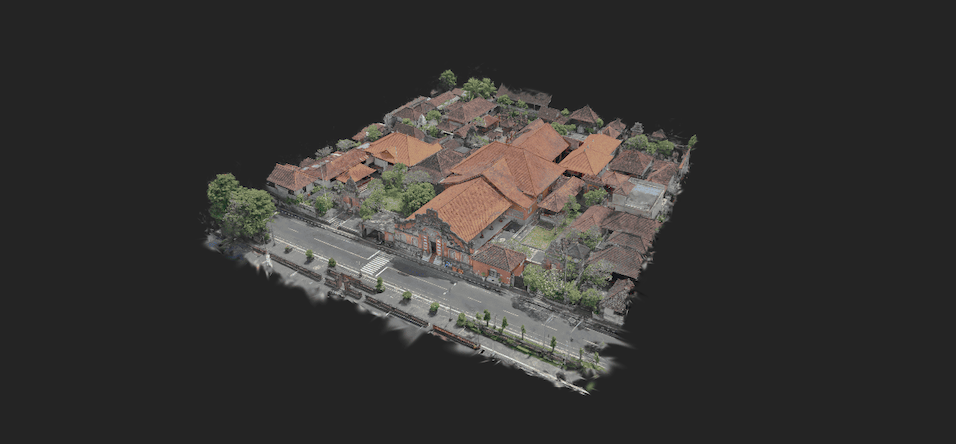
Three-dimensional Gaussian Splatting (3DGS) enables the high-fidelity reconstruction and rapid rendering of physical objects and spaces while producing highly portable files, enhancing immersive 3D cultural heritage visualizations. Although existing quality metrics demonstrate technical excellence in encoding accuracy and perceptual quality, stakeholders’ perspectives on this technology and their willingness to adopt it remain largely unexplored. A human-centered evaluation is therefore needed to assess the technology’s practical viability in cultural heritage preservation contexts. Using questionnaires and semi-structured interviews supported by static and interactive visualizations of Puri Klungkung, a Balinese palace in Indonesia, we collected quantitative and qualitative data from eight local experts in history, archaeology, vernacular architecture, and heritage conservation. Our results suggest that experts evaluate 3DGS and photogrammetry differently in both static and interactive visualizations. 3DGS was consistently preferred for close-up views containing complex elements, such as vegetation, water, and architectural details, and was perceived as providing better detail preservation, visual quality, and geometric accuracy. The two techniques received comparable ratings for their representation of materiality and spatial perception. Photogrammetry was preferred for scholarly dissemination because of its greater geometric accuracy and level of detail. By contrast, 3DGS in its current form, appears better suited to public-facing projects, where its visual elements generate more photorealistic renderings, although its geometric accuracy may be lower. Considering the target users’ needs from the outset of the project is therefore important when selecting the most appropriate visualization technique. The thematic analysis yielded recommendations concerning applicability, user familiarity, visual properties, interactivity, and practical implementation, guiding effective visualization of historical Hindu cultural heritage sites in South and Southeast Asia.
DOI: https://polipapers.upv.es/index.php/var/article/view/25551
Tags: 3D Gaussian Splatting, cultural heritage, visualisation, human-centred evaluation
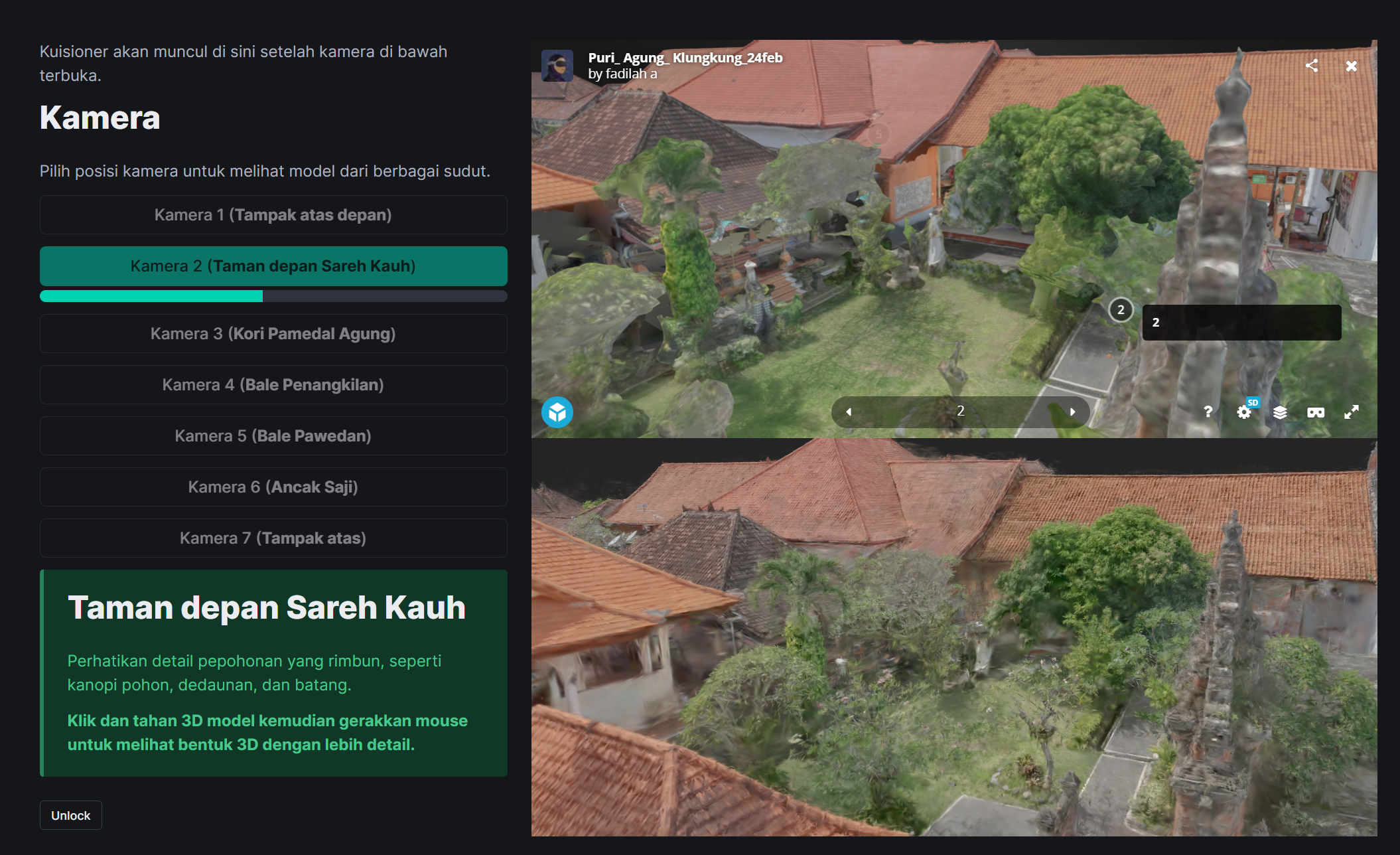
A screen capture of the visualisation probe we used in the interview. It compares photogrammetry and 3DGS representations in multiple camera angles.
Link to github repository: https://github.com/KadekSatriadi/3dgs-sketchfab-vizprobe
Acknowledgement
We thank the Indonesian Ministry of Culture in Jakarta for allowing access to Puri Klungkung photogrammetry data and the 3D model. This work is supported by Monash eResearch capabilities, including High Performance Computing (HPC), and is within the context of the Bali Digital Heritage Initiative.Related Publications
-
Participatory 3D Documentation of Thousands of Balinese Temples: A Preliminary Study
Kadek Ananta Satriadi, Made Windu Antara Kesiman, Putu Hendra Suputra, I Gede Mahendra Darmawiguna, Tom Chandler, Bernhard Jenny, Kadek Teguh Dermawan, I Made Gede Sunarya, Joshua Seguin, Viviane Frings-Hessami, I Gede Danan Aria Satwika Punia, I Kadek Dwi Angga Sathya Nanda, Lanang Surya Darma, I Putu Bayu Ananta Surya, and Anthony Wilson -
In-Situ Gaussian Splatting-generated 3D Thermal Mesh Visualization for Urban Trees in Augmented Reality
Chaimaa Delasse, Dario Billi, I Gede Mahendra Darmawiguna, Kadek Ananta Satriadi, Arnadi Murtiyoso, Hélène Macher, Vincent Lecomte, Rafika Hajji, Tania Landes -
3D Gaussian Splatting for Archival of Balinese Temples from Community-Sourced Videos
Anthony Wilson, Arnadi Murtiyoso, Bernhard Jenny, I Gede Mahendra Darmawiguna, Putu Hendra Suputra, Thomas Chandler, Made Windu Antara Kesiman, Kadek Ananta Satriadi -
When Temples Travel: Towards Understanding Cultural Impacts of Visualizing Sacred Sites in Foreign Contexts
I. G. M. Darmawiguna, Kadek Ananta Satriadi, Thomas Chandler, Bernhard Jenny, Made Windu Antara Kesiman, Putu Hendra Suputra, and Kadek Teguh Dermawan -
MM-WiMs: A Navigation Interface in ICH Multiscale Virtual Environments
Chenxin Zhang, Yong Hu, Kadek Ananta Satriadi, Xukun Shen