Wilson, A., Murtiyoso, A., Jenny, B., Darmawiguna, I. G. M., Suputra, P. H., Chandler, T., ... & Satriadi, K. A. (2025, October). 3D Gaussian Splatting for Archival of Balinese Temples from Community-Sourced Videos. In 2025 IEEE International Conference on Imaging Systems and Techniques (IST) (pp. 1-6). IEEE.

Kadek Ananta Satriadi
Human-centred computing researcher specialised in visualisation and spatial computing technologies.
3D Gaussian Splatting for Archival of Balinese Temples from Community-Sourced Videos
Anthony Wilson, Arnadi Murtiyoso, Bernhard Jenny, I Gede Mahendra Darmawiguna, Putu Hendra Suputra, Thomas Chandler, Made Windu Antara Kesiman, Kadek Ananta Satriadi
IEEE International Conference on Imaging Systems and Techniques.
Strasbourg, France.
2025. Publication type:
full paper.
This publication is student-led.
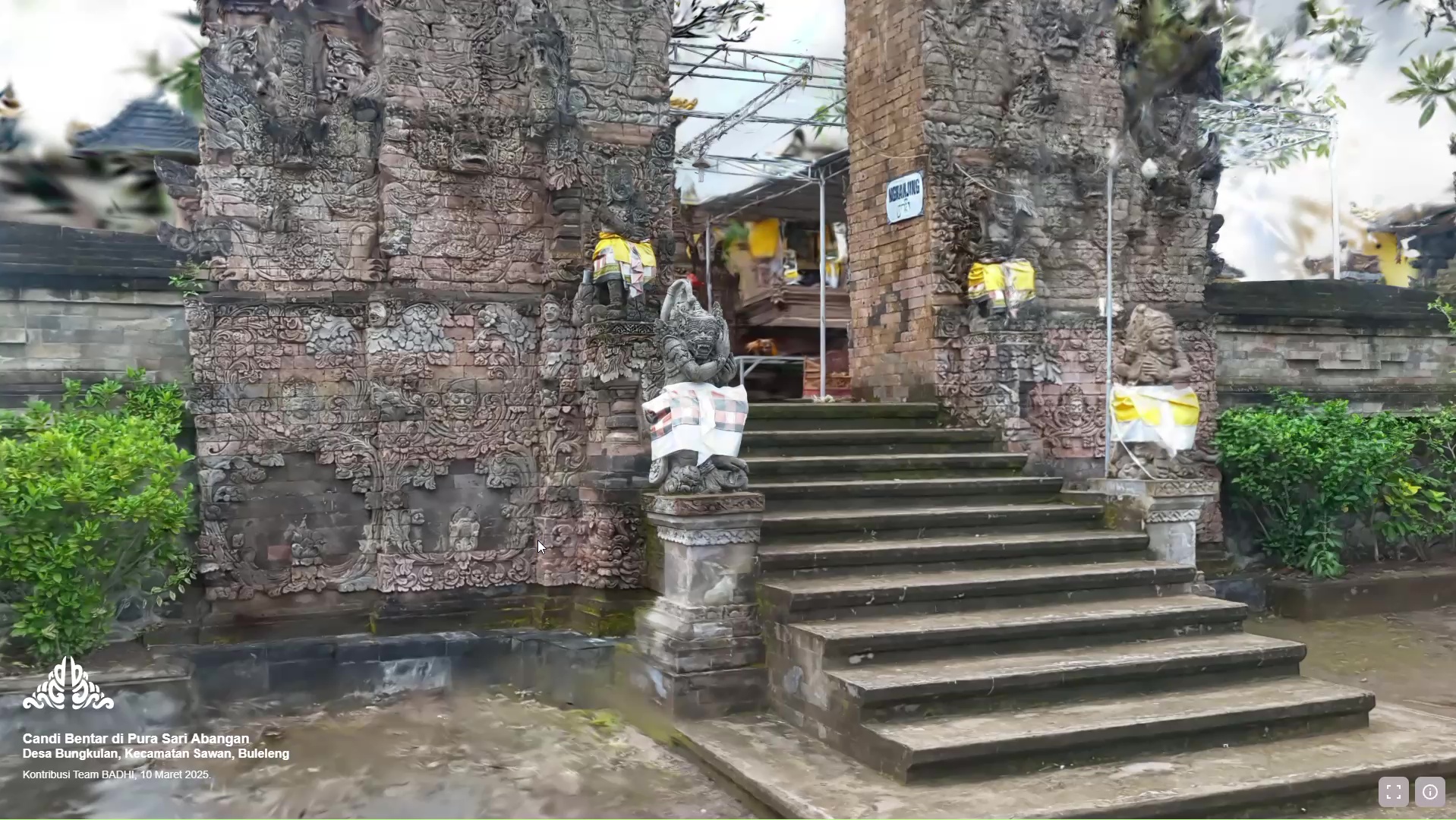
We present a novel application of 3D Gaussian Splatting (3DGS) for the large-scale archival of thousands of temples in Bali. Our project, the Bali Digital Heritage Initiative, adopts a participatory approach in which local communities collect video footage of these vulnerable temples, which we transform into 3DGS scenes to serve as digital archives. Unlike existing approaches that require uploading curated sets of images, video contribution simplifies the process for the community. We expect this to encourage a high participation rate and increase the number of archived temples. However, these community sourced videos are often of variable quality and usually aren’t ideal for 3D reconstruction, introducing technical challenges. This paper first presents several key challenges in the development of the 3DGS pipeline in this context, including managing video quality, combining multiple videos, ensuring reliable results from Structure from Motion, and maintaining the visual quality of 3DGS scenes. We then propose solutions to many of these challenges by introducing a postprocessing stage that cleans up the scene through a series of purpose-built 3DGS filters. These filters consider attributes of Gaussian primitives, including local density, geometry, and colors. Finally, we discuss future research directions to address unsolved challenges and improve the performance of the pipeline.
DOI: https://doi.org/10.1109/IST66504.2025.11268436
Slides: download
Tags: 3D Gaussian Splatting, cultural heritage, crowdsourcing
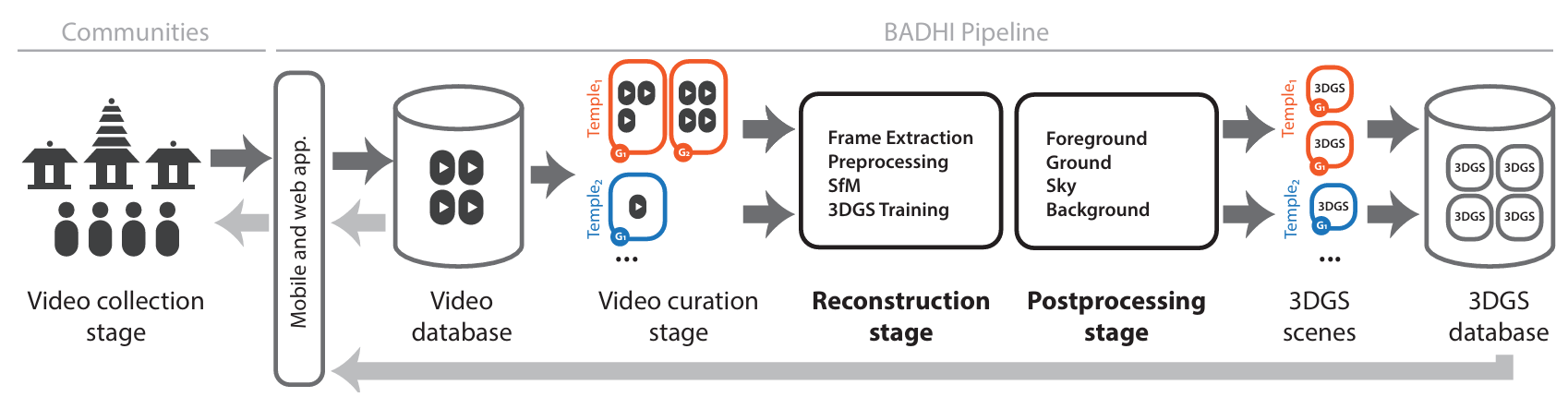 The overview of our approach to participatory archival of cultural heritage sites, including a video collection stage with a mobile application, a databases for videos, a video curation stage for selecting and grouping of videos, 3DGS reconstruction and postprocessing stages, the combination of multiple 3DGS scenes, and a database with reconstructions. This paper focuses on the reconstruction and postprocessing stages.
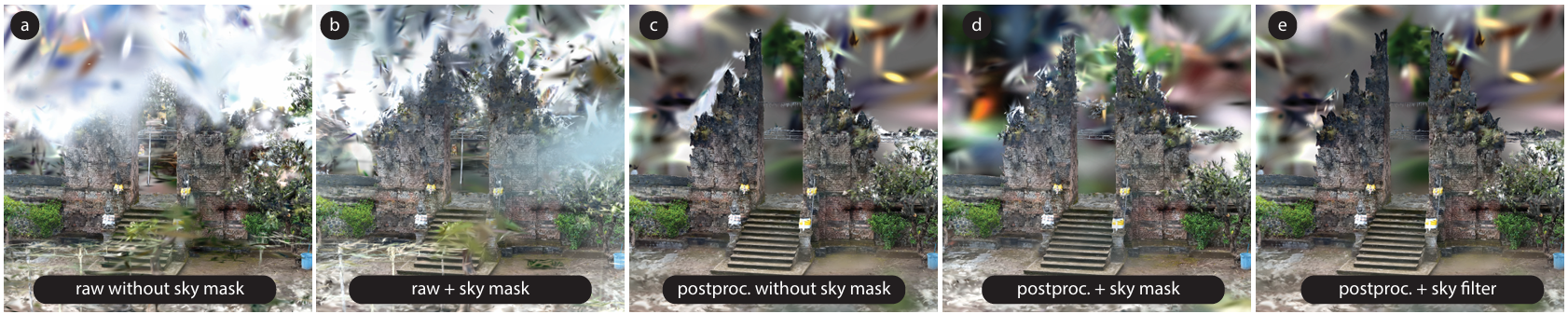 Raw 3DGS is the output of the reconstruction stage that often contains floaters (a). Sky masking is an optional preprocessing step in the reconstruction stage aimed to reduce these floaters, but does not always yield satisfying results (b), even when combined with the postprocessing stage (d). The default postprocessing results on their own usually leave some sticky sky (c). The postprocessing stage with a sky filter activated provides the cleanest output (e).
For more information, read our paper or look at our slide presentation above.
Acknowledgment
This publication is part of the BADHI project.
We thank the Whyte Fund and the Monash University Winter Scholarship program for the funding support, and Universitas Pendidikan Ganesha for the logistical support. Furthermore, this paper was published within the context of the Digital Twins for Cultural Heritage (Twin4CH) Ju nior Professorship Chair at INSA Strasbourg, funded by the French National Agency for Research (Agence nationale de la recherche– ANR).
Related Publications
-
Towards a human-centered evaluation of 3D Gaussian Splatting for cultural heritage visualization
Fadilah Husna Arief, Kadek Ananta Satriadi, Erik Malcolm Champion -
In-Situ Gaussian Splatting-generated 3D Thermal Mesh Visualization for Urban Trees in Augmented Reality
Chaimaa Delasse, Dario Billi, I Gede Mahendra Darmawiguna, Kadek Ananta Satriadi, Arnadi Murtiyoso, Hélène Macher, Vincent Lecomte, Rafika Hajji, Tania Landes -
When Temples Travel: Towards Understanding Cultural Impacts of Visualizing Sacred Sites in Foreign Contexts
I. G. M. Darmawiguna, Kadek Ananta Satriadi, Thomas Chandler, Bernhard Jenny, Made Windu Antara Kesiman, Putu Hendra Suputra, and Kadek Teguh Dermawan -
MM-WiMs: A Navigation Interface in ICH Multiscale Virtual Environments
Chenxin Zhang, Yong Hu, Kadek Ananta Satriadi, Xukun Shen